

2026
The Work we’re excited about
TOOLKITS
The Caregiver Toolkit
A practical infrastructure for caregiving realities
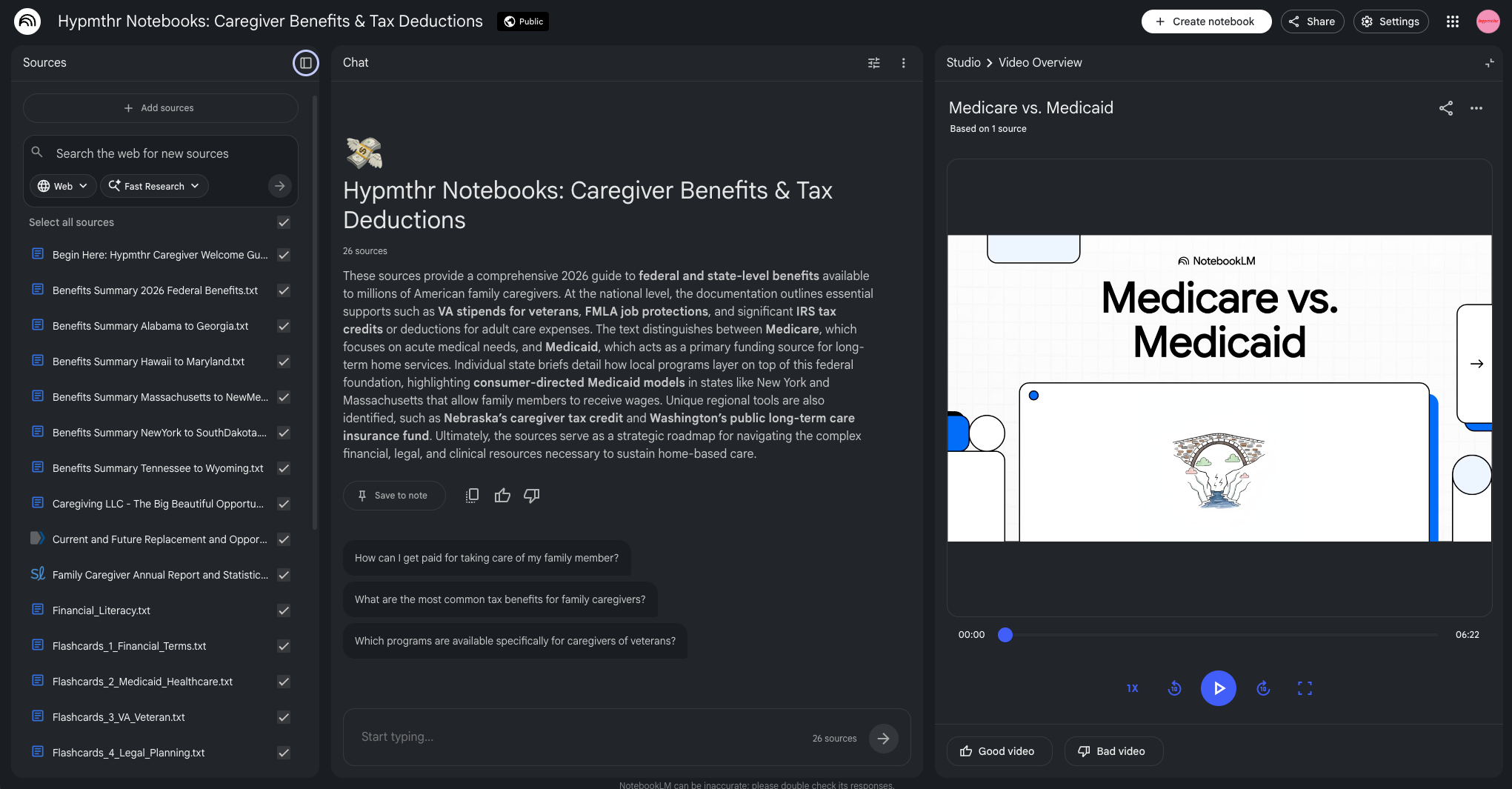
Caregiving comes with a second job nobody trains you for — navigating benefits, understanding Medicaid, figuring out what your state actually offers, and making financial decisions with incomplete information. The Caregiver Toolkit was built to close that gap.
The core of the toolkit is a free Google Notebook powered by research-driven source documents covering all 50 states. You can ask it questions in plain language — about your state's caregiver benefits, Medicaid rules, VA programs, tax implications, LLC structures, and more — and get clear, specific answers grounded in real policy.
We chose Google Notebook intentionally. It lets people have a conversation with the research instead of reading a 200-page document. You ask what matters to you. It answers from the source material. No account required. No downloads. Just a link and a question.
The toolkit also includes a caregiver glossary — a plain-language reference for the financial, legal, and healthcare terms that come up when you're caring for someone and trying to protect your household at the same time.
This work is built from qualitative research, policy analysis, and lived experience. It is designed to be adaptable, expandable, and ready for integration — whether as a standalone resource, an internal program, or a foundation for future product development.
Our Near-Death Experience research examines how people make meaning at the edge of life — and how those experiences quietly influence belief, behavior, identity, and care practices long after they occur. Drawing from large qualitative datasets, narrative analysis, and cross-disciplinary research, this work treats NDEs not as anomalies, but as data.
Rather than attempting to explain these experiences away, the research focuses on patterns: what people report, how they describe transitions, and how these accounts reshape their understanding of life, death, and connection. The work creates space for rigor without reduction — acknowledging that meaning-making itself has psychological, cultural, and systemic consequences.
This research informs education, clinical understanding, and public discourse, offering a grounded way to engage experiences that are widely reported yet rarely integrated into institutional knowledge.
RESEARCH
Near-Death Experience (NDE) Content Study
Studying meaning, consciousness, and what persists
TRAINING /
CONSULTING
Workplace Transition: The Human Response to Loss
Understand behavior during change, without misdiagnosing it.
A structured approach to understanding how loss, change, and attachment shape behavior in the workplace.
This curriculum reframes organizational transition as a form of loss. Rather than treating behavioral changes as performance or attitude problems, it examines how the brain responds to disrupted expectations, identity shifts, and uncertainty. Participants develop a clear understanding of how grief affects attention, memory, decision-making, and social behavior, and how these changes appear in everyday work.
The work moves from recognition to application. It introduces a shared language for interpreting behavior, distinguishes between expected responses and true performance issues, and provides practical ways to respond without increasing pressure or misdiagnosing the problem. This includes understanding cognitive load during periods of change, the role of attachment in workplace identity, and the conditions required for stability and adaptation.
The curriculum can be delivered as a single session, a multi-part course, or embedded into ongoing leadership and team development. It is designed to hold up across contexts, whether applied in moments of acute disruption or within environments defined by continuous change.